


The Liveability State of Origin: The real rivalry isn’t between Queensland and New South Wales
Article


Head of Customer and Commercial (Government)
This article was written by Dan Evans and first appeared on LinkedIn.
Most discussions about Australia's population focus on volume: how many people we're adding each year, natural change versus migration, where the growth is happening, and what that means for infrastructure, services and culture.
These are worth discussing, but volume and location alone lack the depth strategic decisions require. What gets less airtime is age composition, specifically ageing, and how it shapes the way we invest and design services for older Australians.
Informed Decisions' National Forecasting Program tells us the number of Australians aged 60 and over will rise from around 6.5 million today to just over 9 million by 2045, a 38% increase. Over the same period, the population under 60 will grow by just 20%, close to half the pace. Step it out in five-year increments and the acceleration becomes clear.
This is a structural re-weighting of the nation's age profile. Decisions made this decade, about where money flows, what we build and the skills we need, will determine how well Australia serves its fastest-growing cohort. One of the less obvious of those decisions is public transport.
On the surface, you could be forgiven for thinking public transport is for school kids, uni students and workers heading to the central business district. That imagery leaves out a group with arguably one of the strongest cases for reliable, efficient services: older Australians.
Insights from our 2026 Living in Australia survey speak directly to this. When Australians aged 60 and over are asked what makes somewhere a good place to live, they nominate 'feeling safe' (67% put it in their top five), 'high-quality health services' (55%), 'reliable and efficient public transport' (50%), 'access to the natural environment' (50%) and 'a strong sense of community' (41%).
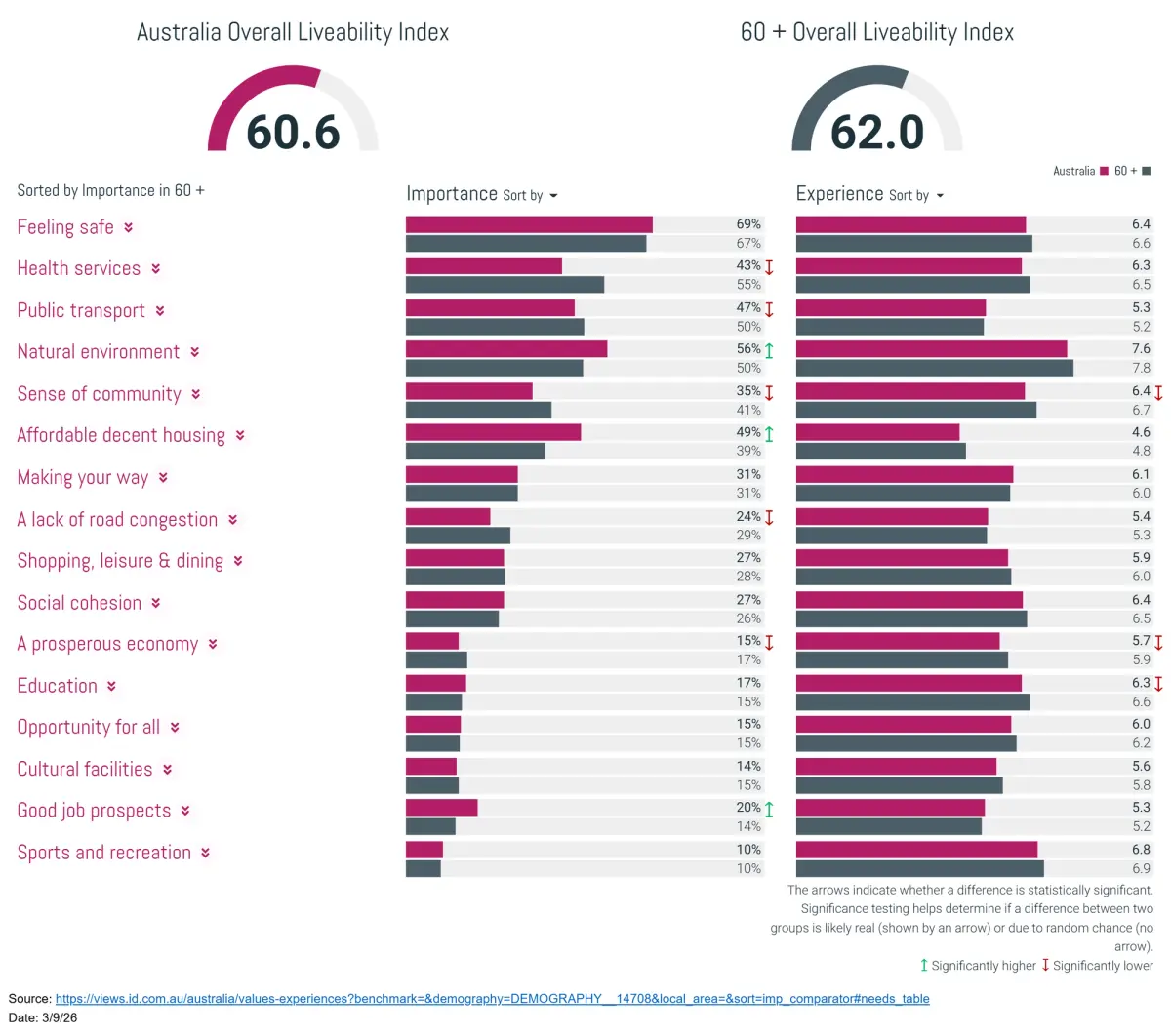
Some of that makes intuitive sense. Of course older Australians rate health services highly, because they are more likely to be using them. What is more of a surprise is public transport: reliable, efficient services matter more to older Australians than to younger ones. It is easy to overlook precisely because it is not the priority you would assume.
The shape of the list is instructive in other ways. Both health and transport are rated significantly more important by older Australians than by the general population, while affordable housing and job prospects sit much lower for them than nationally. Priorities shift with life stage, and the infrastructure we plan for needs to shift with them.
Now look at how those priorities are being met on the ground, and a service gap opens up. Older Australians report broadly similar experiences to younger Australians on both health and transport where they live. But compare the two across local areas and health services are consistently rated more positively than public transport. Older Australians rate feeling safe at 6.6 out of 10 and health services at 6.5; public transport scores just 5.2, the widest gap between importance and experience anywhere in their top tier.
That gap is the point. Better public transport lifts liveability for everyone, but it does the most for older Australians and, as the population ages, for more of us over time.
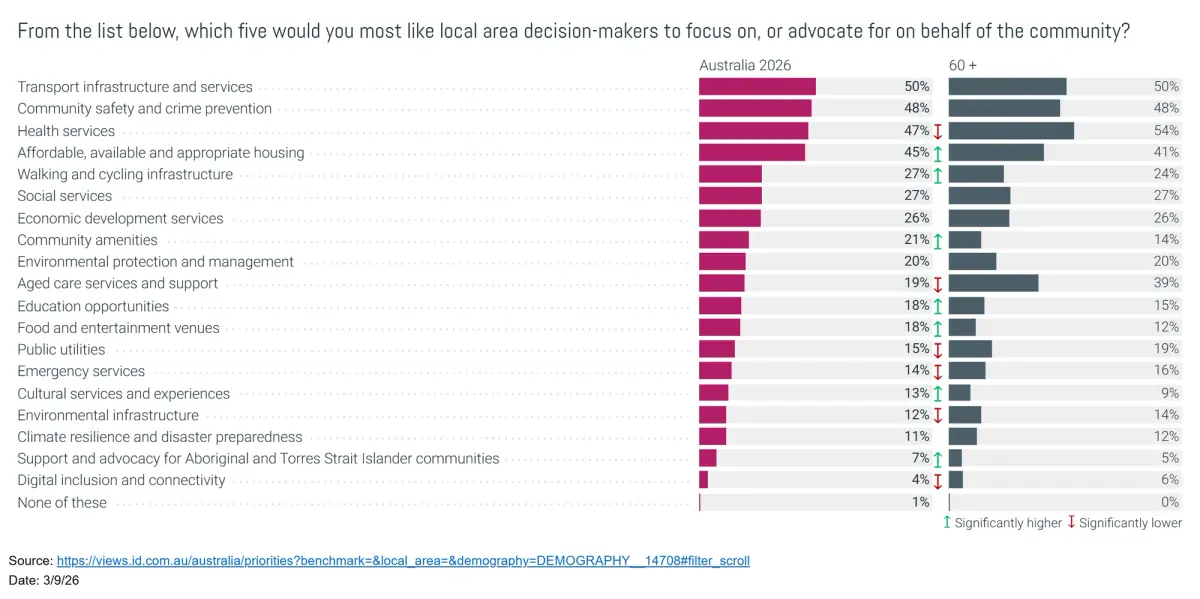
Zoom out to what residents most want local decision-makers to advocate for, and transport rises to the top of the national list. For Australians aged 60 and over, it sits second only to health services. Across every framing in the survey, older Australians say the same thing: public transport matters, and current provision falls well short.
Older Australians aren't asking for better buses and trains for their own sake. Public transport is a proxy for agency, health, wellbeing and purpose.
Australians aged 60 and over score highest of any age group on our Health and Wellbeing Index, 7.4 out of 10, driven by strong mental health (7.9) and social wellbeing (7.4). Those scores come from staying engaged beyond the front door: family, community, work, volunteering.
As we age and driving becomes harder, public transport is the bridge between independence and isolation. The evidence is well established: accessible transport in later life is linked to lower loneliness, slower physical decline and better health. Take it away and the opposite follows: as people withdraw, their activity, health and wellbeing go with them. It also erodes how safe an area feels, the strongest driver of liveability, but that is a subject for another article.
The wellbeing older Australians report today has been built over a lifetime. Investing in reliable, efficient public transport will help hold off its decline deep into later years.
Liveability isn't measured in isolation. The score reflects the gap between what residents value and how they experience it: high importance plus low experience drags liveability down, and lifting experience on something that matters pulls it up. For older Australians, public transport is exactly that lever, a top-three priority where experience trails. Close the gap and you lift liveability for the 60+ cohort, and, because good transport is used by everyone, for every other age group too.
One caveat matters here. These are national figures. They point to where pressure is building, but they are a general view. What is most instructive for actual decisions is the lived experience of residents in a specific local area, which is what Community Views measures. Ageing, transport access and liveability look very different in an outer-metropolitan growth corridor than in a regional centre or an inner-city suburb. Clarence Valley Council built its long-term strategy around that kind of local evidence. The national numbers give us the headline, but local data should guide the investment.
The timing argument is unavoidable. Major transport projects (heavy and light rail, busways, network extensions, accessibility upgrades) take years, often decades, to plan, procure and deliver. The people who will benefit most are already here, and the 60+ population will keep growing at close to twice the rate of the rest of the country through to 2045. On those lead times, the projects that serve this cohort need to be starting now.
So sustained, intentional investment in public transport, especially across the suburbs, regional centres and outer-metropolitan corridors where ageing is most concentrated, is not a nice-to-have. It is among the highest-leverage investments government can make for liveability across every age group.
The risk is that infrastructure keeps being decided through the lens of headline population growth, with composition treated as secondary. The data says composition deserves equal weight.
National figures show where the pressure is building. The decisions that matter play out suburb by suburb, and that is where the evidence needs to come from.
Local evidence
The 2026 Living in Australia results show what residents value about where they live, how they rate their own area, and how both of those change with age.
