


What’s wrong with the world’s most liveable cities?
Article


Head of Customer and Commercial (Government)
Watch the recording or view the slides from Dan's presentation at 'A way forward for Wyndham', in which he presents an evidence base for why investing in growing areas like Wyndham matters not just for the future of the city, but for the future of Victoria.
Wyndham's case for transport and social infrastructure investment is grounded in an integrated understanding of community and place: how the City's population has grown and will continue to grow, its changing demographic and cultural characteristics, the evolving shape of its economy, its role within the region, and what residents themselves say needs to happen to improve their quality of life. It reflects a council acting on what matters.
Daniel Evans, Government Services Lead, Informed Decisions
I recently spoke at the launch of the City of Wyndham's advocacy campaign, A Way Forward for Wyndham, ahead of this year's Victorian state election. It's a campaign asking the Victorian Government to invest in the transport and social infrastructure a fast-growing community needs, and I was there to lay out the evidence behind it. Wyndham's asks are evidence based, informed by a clear read of who lives there, where the community is heading, and what metropolitan growth area residents say they need to advance liveability.
Here's a summary of what I spoke to on the day, and why this approach matters beyond Wyndham.
Before any of the numbers, it's worth pausing on Wyndham's geography, because it gives the place real structural advantages. It's relatively close to the Melbourne CBD, positioned between two large regional cities, Geelong and Ballarat, and between two airports in Avalon and Melbourne. Add the major arterials, the port and a serious industrial base nearby, and you have a place well connected into the broader region, one whose role and function only make sense in that wider context. The fundamentals help too: the land is relatively flat, and there's a lot of it, framed by metropolitan Melbourne on one side and regional Victoria on the other. It's hard to think of a place better positioned for the long term.
On top of those advantages sits a remarkable growth story.
In 2001, Wyndham had just over 85,000 people. Today it's nearly 348,000, around 400% growth in a single generation, still running at about 6% a year against a state average closer to 2%. That's the equivalent of adding Ballarat and Bendigo combined onto a series of established outer suburban areas. By 2046 we forecast nearly 480,000 people will live in the LGA.
And here is the face of that growth: young families. A specific cohort of people keeps choosing Wyndham: young, diverse, increasingly well-educated, where 40 to 60% of households are paying off a mortgage. These are people who've come to build a life, not to pass through. And they are exactly the people these investments are for.
[caption id="attachment_16871" align="alignnone" width="932"]
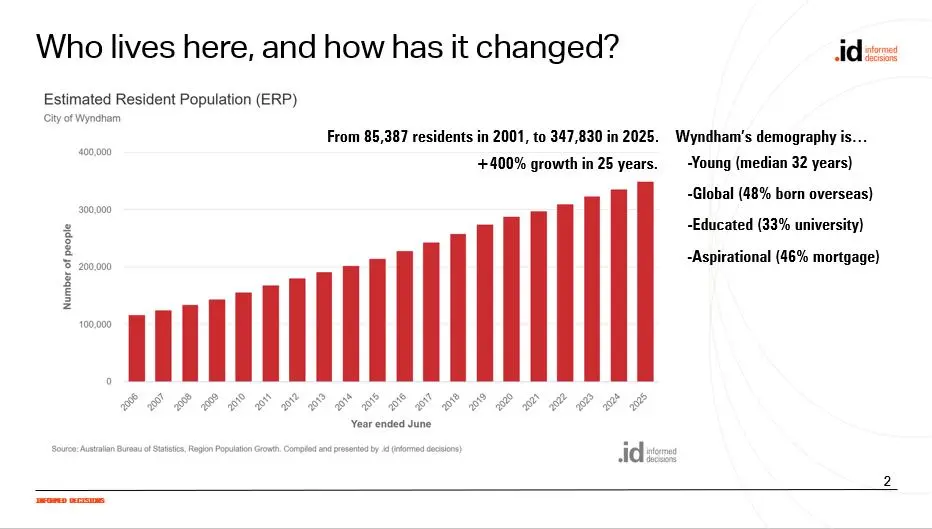
Wyndham's estimated resident population growing from 85,387 in 2001 to 347,830 in 2025, a 400% increase in 25 years[/caption]
That's happening on the back of a diverse and growing economy. Wyndham's economy has grown from $5.2 billion to $19.6 billion, and its share of Victoria's economy has doubled, from 1.6% to 3.2%. Local jobs are spread across transport and logistics, education and training, retail trade, healthcare and construction, and that diversity gives the economy real resilience. Its prosperity isn't going to rise or fall on any single macro event. It's also increasingly tied to the prosperity of Victoria as a whole: when Wyndham does well, Victoria does well.
[caption id="attachment_16872" align="alignnone" width="925"]
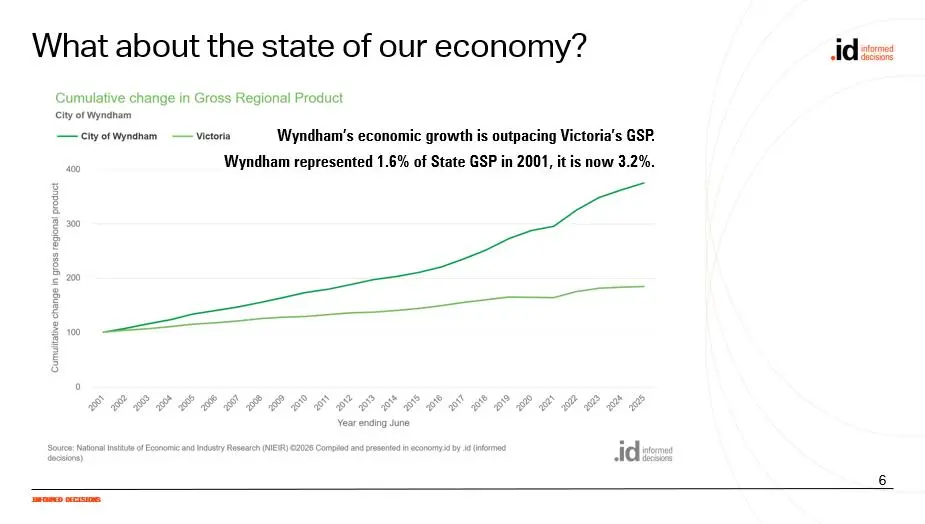
Wyndham's economic growth outpacing Victoria's, with Wyndham's share of state GSP rising from 1.6% to 3.2%.[/caption]
The honest and obvious observation is this: the critical needs of the community have not kept pace with that population growth. The roads, the trains, the hospitals, the pools, the community spaces, they simply haven't kept up. The gap between what residents need to live a higher quality of life and the transport and social infrastructure required to deliver it is widening, and it needs to be addressed.
This isn't a request for a handout. It's a case for backing a region that's already delivering, on position, people, economy and trajectory.
This isn't a request for a handout. It's a case for backing a region that's already delivering.
Dan Evans, Government Services Lead, Informed Decisions
The case rests on two pillars, two simple ideas about what residents of metropolitan growth areas need:
These aren't luxuries. They're the basic, foundational things you need to operationalise your life in an outer-suburban growth area. It's very simple: connect people to opportunity, and connect people to each other.
These two pillars aren't a hunch. They're precisely the things that matter most to people living in metropolitan growth areas, and, at the same time, the attributes those residents report as their poorest local experiences.
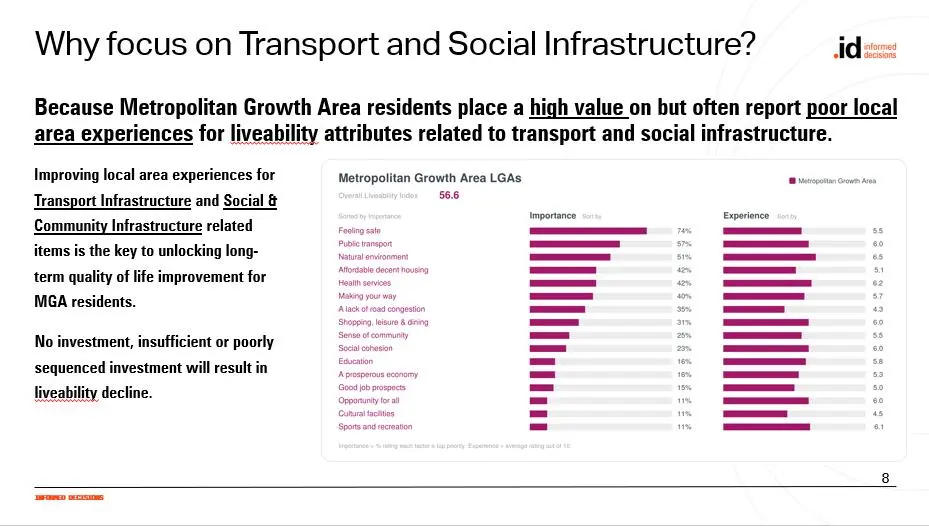
When we ask growth-area residents what makes a good place to live, the same pattern comes through every time. At the very top of the list is feeling safe: 74% rate it a top priority. Then the provision of reliable and efficient public transport, at 57%. High quality health services, at 42%. Making your way to and from services with relative ease, at 40%. And a lack of road congestion, at 35%.
But those same residents report some of their poorest local experiences in exactly those areas. On a ten-point scale, they rate a lack of road congestion at just 4.3, the lowest of anything we measure. Feeling safe sits at 5.5. Making your way, 5.7. The things that matter most are the things falling shortest. These are also the lived experiences where metropolitan growth area residents report significantly worse local area experiences relative to those who call the middle suburbs and inner city their home.
That gap, between what people value most and their local experiences, is the single biggest lever for quality of life in a growing community. Investing in the projects that improve those experiences is precisely what advances local liveability over the long term.
Of all the factors that go into liveability scores, feeling safe is the most foundational. It's the single attribute residents point to most when they describe how they experience where they live, and any movement in perceptions of safety has an outsized effect on quality of life. Put simply, if people don't feel safe where they live, they're less likely to participate in community life, and that carries knock-on effects for both health and economic outcomes.
Perceptions of safety are shaped most of all by crimes against the person, a live dynamic in Melbourne and Victoria right now. While the actual likelihood of being a victim remains very low, the possibility alone is enough to shift how people feel and change day-to-day behaviour.
One response, and one where councils and government have real agency, is investing in the social infrastructure and services that build a sense of community. Our research consistently identifies social connection as one of the strongest drivers of how safe people feel, and, by extension, of local liveability overall. When people share spaces and feel part of something, their sense of safety rises with it.
This is exactly what Wyndham is asking for: the aquatic centre, the indoor sports facilities, the community gathering spaces, the health and mental health services. Strengthen connection and you strengthen the sense of safety that underpins everything else.
And when people feel safer, they participate: they get out, join in, and use the spaces around them. When they don't, they withdraw, with real economic and health consequences. Which is why these investments deliver far more than their price tag suggests.
Pulling it together, Wyndham has shown what good, evidence-led advocacy looks like: layering an understanding of who lives there, who's coming, how it's changed and what's driving its economy with what metropolitan growth area residents themselves say they need. In summary:
That's a way forward for Wyndham. And it's a way forward for Victoria.
Talk to our Government Services team about the evidence base you need for your advocacy.
Daniel Evans leads Government Services at Informed Decisions, working with councils across Australia to build the demographic, economic and community-sentiment evidence base behind their strategic and advocacy decisions.


