GOVERNMENT TOOLS
CONSULTING


Quantifying infrastructure demand under upzoning in Austral

Key highlights
The Client
Liverpool City Council
Their Challenge
Quantifying the impact of high density residential upzoning to a major greenfield area's demographic composition.
The Approach
We sequenced residential development across Austral and Leppington North, using population driven demand assumptions from our National Forecasting Program. We then built an alternative upzoning scenario to test population, household and dwelling outcomes against the base case, year by year to 2041 and at ultimate buildout.
Results
A detailed scenario output and report containing population, households and dwellings figures along with the demographic composition of Austral from 2021 to 2041 and to ultimate buildout.
This project's a few years old, but the challenge for infrastructure planners remains the same: how do you size infrastructure for growth that's outpacing the plan it was built for? The same work to understand development timing and sequencing remains at the core of our method to help utilities forecast demand for connections, capaicty and augmentation timing.
Since the completion of this project, the Federal Government has announced a $1 billion upgrade to connect Fifteenth Avenue with the new Western Sydney International Airport. The announcement follows a campaign by Liverpool City Council, which used findings and projected figures from our upzoning scenario modelling.
In 2013, the NSW Government rezoned the Austral and Leppington North Precincts to enable 17,350 new homes in the South-West Growth Centre. Planning controls encouraged higher housing density, with infrastructure designed for the original target. However, smaller lot sizes (now averaging 300m²) have increased capacity to 25,000 homes, straining resources.
Amid Australia's housing crisis, the precincts aim to support the National Housing Accord by enabling additional homes with matching infrastructure for sustainable growth. This project quantified the capacity of potential future upzoning and produced alternative population, household and dwelling forecasts along with key demographic indicators with which Liverpool City Council could accurately plan for infrastructure needs to 2041 and beyond.
The evidence base from Informed Decisions
Our analysis for this project included:
Micro-area residential development sequencing
Using our recently updated small area residential development assumptions from our National Forecasting Program, we were able to map out where development will occur within the Austral and Leppington North Precincts, when and at which rate of development.
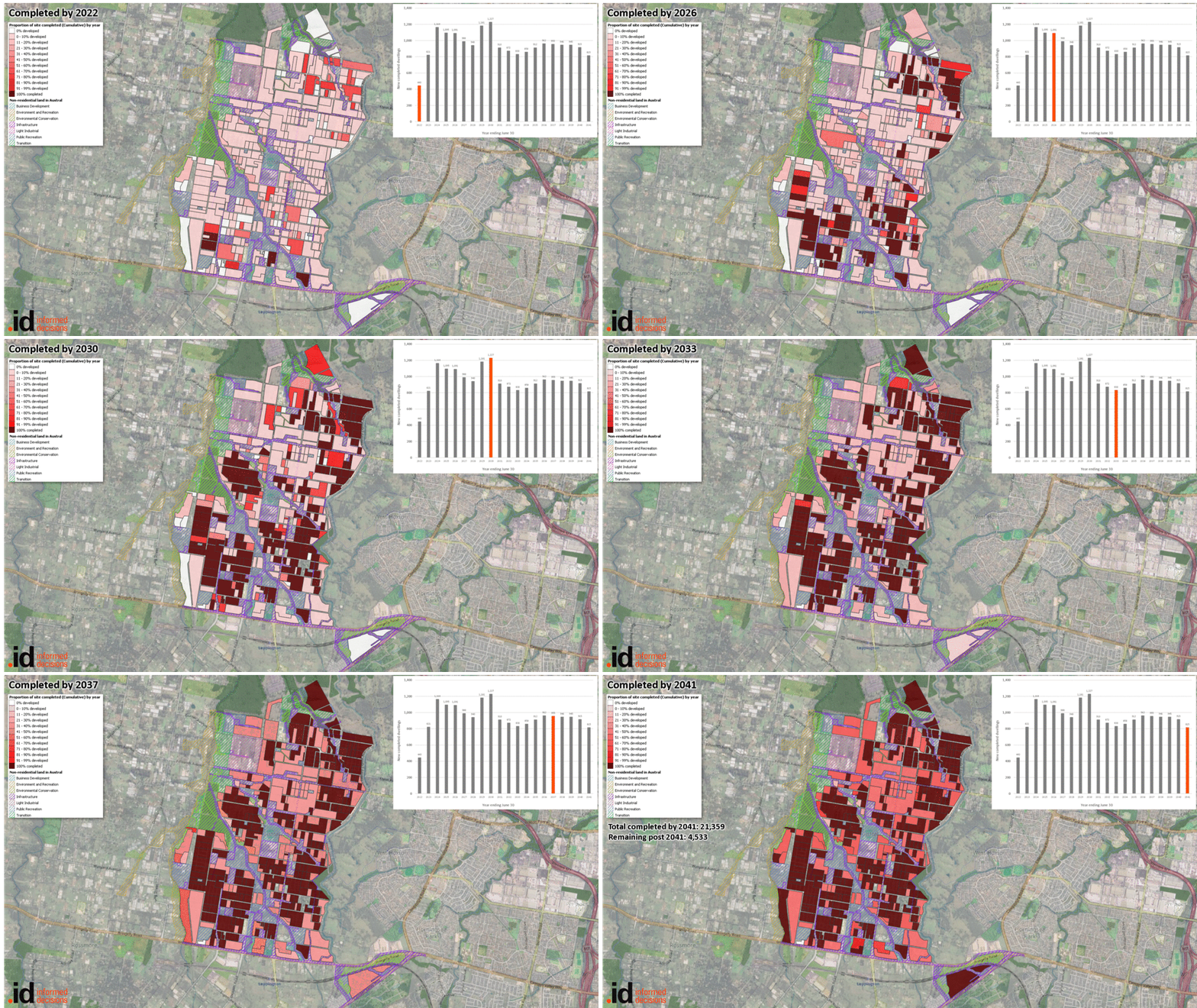
Development sequencing of the Austral and Leppington North Precincts
Demographic composition of Austral and Leppington North
Calculating the future population, households and dwellings totals in Austral, along with characteristics such as average household size and dwelling occupancy rates, for each year from 2021 to 2041, and at ultimate buildout.
Creation of an upzoning residential development scenario
In order to understand what impact a density upzoning would have on Austral and Leppington North Precincts' future population, capacity and therefore, infrastructure needs, Informed Decisions was able to quantify potential yield from upzoning of a segment of Austral, when this scenario would realistically occur and how different the scenario would look (from a population, households and dwellings total, as well as average household size and occupancy rates) in the future.
The preparation of information for use in this project also required an update of residential development assumptions to ensure accurate residential development rates were assumed for 2024 and 2025. This was important, as rates of dwelling construction and completion have slowed down and a detailed verification was necessary.
Next steps
The output from this project allows Liverpool City Council to meet the broader project objective to identify the additional infrastructure and services required to unlock greater housing capacity within the Austral and Leppington North Precincts.
The Liverpool City Council also aims to support thriving and sustainable Western Sydney communities into the future, and the information provided is highly valuable and vital.
Scenario modelling as a means of testing your possible futures
The National Forecasting Program shows how demand for infrastructure and services is forecast to change, by looking at how Australia's overall growth plays out at the local area level. The research combines a nationwide assessment of demographic change with a detailed audit of current and future housing development based on planned development, infill capacity based on zoning and supply and demand drivers.
However, sometimes organisations such as Councils need to test what impact a certain scenario, such as:
- The upzoning of an activity centre
- Changes in policies which result in higher identified housing capacities
- The release of more land currently not zoned as residential or
- Potential impact of economic drivers of future population growth
This is where Infomred Decisions can utilise our rich and detailed information and expertise in order to quantify and describe those scenario outputs with proven, detailed and robust scenario modelling analysis.
Work with us
If you have a project like the one in this case study, send us a note here and tell us what you're working on.