GOVERNMENT TOOLS
CONSULTING


City of Stonnington

Key highlights
The Client
City of Stonnington
Their challenge
City of Stonnington needed an independent, robust and repeatable community survey to understand the values and experiences of its residents, with confidence that the survey sample accurately represented the broader community.
The approach
Via Stonnington's Views, we surveyed over 1,000 Stonnington residents using social media advertising, the best available methodology to generate large and diverse samples across small geographic areas. Council also promoted the survey on its own social channels, generating an additional 71 responses.
Results
The sample profile achieved via social media advertising compared favourably to the population and outperformed a comparable telephone-based survey at reaching young people, renters, and residents who speak a language other than English. Social media advertising is a viable, cost-effective way to achieve a large sample within a local government area.
The rise of social media advertising as a sampling methodology
The primary goal of a survey is to accurately reflect the target population. However, surveying every individual is neither feasible nor necessary. Instead, sampling enables large-scale research to be conducted more efficiently by selecting a smaller group of individuals with representative characteristics, making the process more cost-effective and time-efficient.
Social media platforms like Facebook and Instagram have become increasingly popular tools for generating a sample of participants for online surveys. The vast majority of Australians are using some form of social media, and that number is growing every year. According to industry statistics, 20.5 million (80%) Australians accessed social media in January 2021 and approximately one-third of our entire time online was spent engaging with social media.
There is a growing body of international research exploring how well social media advertising performs for surveying purposes, with one recent study from the Max Planck Institute for Demographic Research concluding that "the FAM (Facebook Ads Manager) is a valuable and largely reliable tool for research".
Informed Decisions has been at the leading edge of using social media advertising to help our local government clients better represent their community's views using surveys since 2019, and our trials and client work using this approach continue to reinforce our belief in the benefits of this method. We have been able to deliver large and representative samples in a diverse range of different geographies, for example rural areas such as Tamworth NSW, urban fringe growth areas such as Sunshine Coast QLD, suburban areas such as Canning WA and inner city areas such as Stonnington VIC.
Stonnington's Views
Our work for City of Stonnington in particular illustrates the effectiveness of social media advertising for local area sampling. In comparing the profile of our social media advertising sample with population statistics (via the ABS Census) and the sample achieved in Stonnington's 2024 Community Satisfaction (CSAT) Survey undertaken by telephone, we found that the Stonnington's Views social media sample:
- Achieved a higher proportion of young people in the sample than the telephone survey (8% versus 5% telephone, against 12% of the population)
- Achieved a lower proportion of men (41% versus 47% for telephone, against 47% of the population)
- Achieved a higher proportion of renters (37% versus 21% telephone, against 46% of the population)
- Achieved a higher proportion of those that speak a language other than English (22% versus 17% telephone, against 22% of the population)
- Achieved a representative sample by Ward (groupings of suburbs)
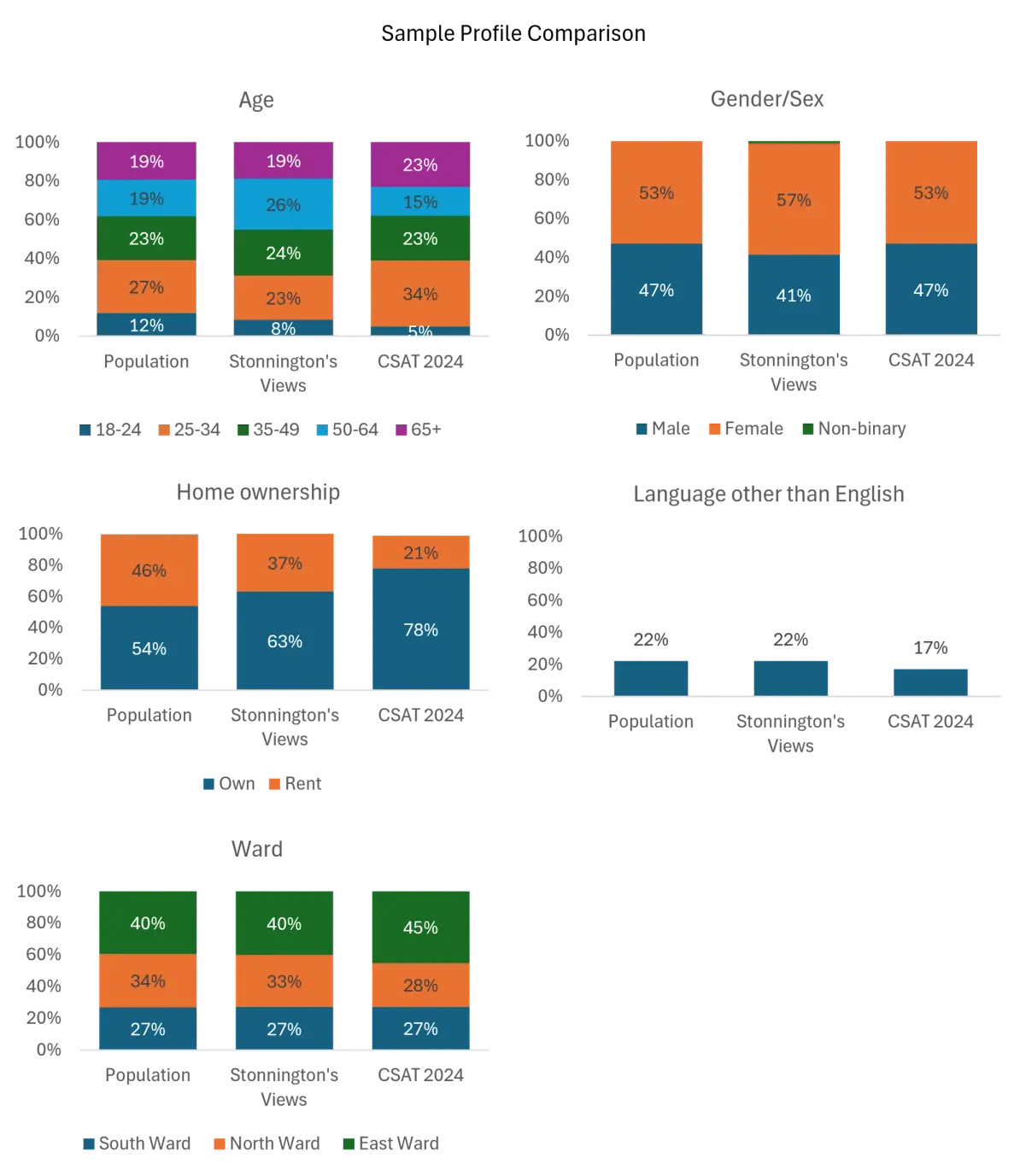
Additionally, the final data for Stonnington's Views was weighted by age, gender and local area to match population statistics. Data-weighting is a common practice in social research, allowing us to improve the representativeness of survey results. It essentially amplifies the voices of those that are under-represented (for example, men and younger people) and softens the voices of those that are over-represented (for example, women and older people).
Beyond improving representation, our approach to using social media advertising is considerably more cost effective than telephone methodologies, which means greater volumes of the community can participate in the survey for the same or less investment. A lower cost per survey helps increase the overall sample size which, in turn, delivers sub-LGA local area analysis and reporting, and the ability to drill into the views and needs of specific cohorts (for example, how safe females feel in their suburb). The social media advertising method is also considerably faster to complete than a telephone approach.
This work demonstrates that social media advertising offers a practical and budget-friendly approach to reaching a large sample within a local government area, reflecting and surpassing the demographic representation of a comparable telephone survey.
If you would like to read more about how we have weighed up the pros and cons of each data collection method for local area sampling (including telephone, list-based surveying and online panels), refer to this article.
Want to find out more?
Community Views is an independent, robust and repeatable community survey that helps local councils and other organisations to credibly, comprehensively and efficiently represent their community's views and needs in policy and advocacy. Book an introduction.