GOVERNMENT TOOLS
business
CONSULTING



Yarra Ranges

Key highlights
The Client
Yarra Ranges Council
Their Challenge
Yarra Ranges Council needed a shared evidence base that brought together community priorities with demographics, housing, economic conditions and future growth, so it could target investment and advocacy where it would make the biggest difference.
The Approach
Yarra Ranges enlisted the help of Informed Decisions to deliver Community Views through an online survey conducted from 22 September to 20 October 2025 (n=1,168, weighted by age, gender and local area). We integrated the results into the Views reporting and exploratory platform alongside Council’s demographic, forecasting, housing and economic data.
Results
Council now has one source of truth for community views and local area data, enabling clearer strategic planning, stronger advocacy, and more targeted investment based on where needs are greatest and for whom.
One shared evidence base for targeted action
Yarra Ranges is not one single homogenous community. It is a municipality made up of distinct local areas, ranging from the established outer suburbs of Melbourne’s east through to the forested hills and valley towns of the Yarra Valley. Each area has its own spatial, demographic and economic characteristics, shaping different needs and pressures. While understanding these dynamics provides a strong foundation for planning, Council also needed to extend its understanding to include the community’s values, lived experiences and priorities for advancing quality of life.
Through the Informed Decisions platform and the Community Views study, Yarra Ranges now has a single source of truth that integrates community sentiment with population forecasts, housing data, socio-economic indicators and economic conditions.
This integrated view matters because the data shows that while liveability in Yarra Ranges is strong overall, lived experiences are not uniform across the local government area.
The municipality recorded an Overall Liveability Index score of 63.0 out of a possible 100, above the Australian average (59.5). Residents overwhelmingly value feeling safe, access to the natural environment and a strong sense of community. In many areas, these priorities were matched by strong positive lived experience.
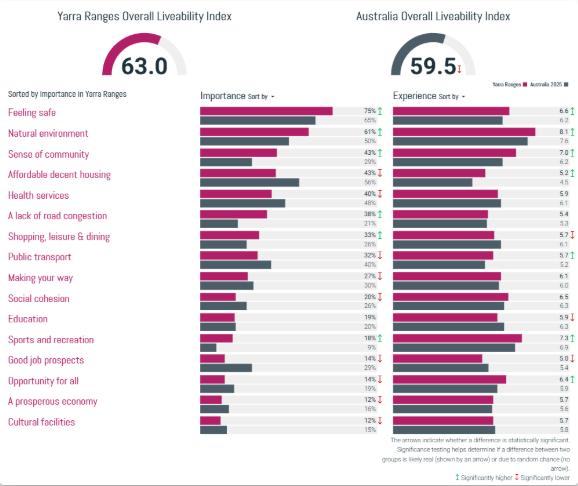
However, the shared evidence base reveals meaningful place-based differences that enable Council to focus investment where it is most needed, and for the residents who need it most.
The Hills (e.g. Belgrave, Olinda, Monbulk) achieved the highest liveability score (68.5), with residents reporting particularly strong positive lived experience of safety, connection and access to nature. In contrast, Yarra Valley (e.g. Warburton, Yarra Junction, Wesburn) recorded the lowest liveability score (57.6). Residents in this area report comparatively weaker lived experience of reliable and efficient public transport, their ability to make their way to and from key services with ease, and the provision of high quality health services. Nearly half of Yarra Valley (48%) residents say they cannot access a hospital within the LGA, compared with just 16% in the Hills.
Healesville–Yarra Glen (e.g. Healesville, Yarra Glen, Toolangi) residents similarly report lower lived experience of public transport and health services, while Urban areas (e.g. Lilydale, Mooroolbark, Kilsyth), which accommodate higher density and commuter populations, experience greater pressure around road congestion and growth.
Across the municipality, affordable decent housing stands out as a key gap. It ranks highly in importance but low in lived experience, highlighting structural housing affordability pressures as population grows and household types shift.
These differences are not anecdotal. They are measurable, geographically defined and grounded in demographic and economic context. Council can see not only what matters most to residents, but where expectations are not being met, and how those gaps differ across place and cohort.
Directly informing the Council Plan and Health and Wellbeing Plan
The value of this work is that it feeds directly into Council’s strategic framework.
Yarra Ranges’ Views has provided a measurable baseline for resident values, experiences and wellbeing across all Council Plan themes. Under the Council Plan’s focus on ‘Healthy Connected Communities’, Council can clearly see where positive lived experience is strong and where targeted action is required, such as improving access to health services or lifting perceptions of safety in particular local areas.
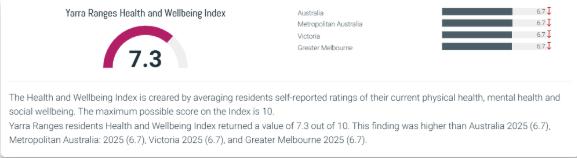
The findings also strengthen the Health and Wellbeing Plan by quantifying physical, mental and social wellbeing outcomes and linking them to structural factors such as transport accessibility, housing stress and ageing demographics. With a median age above Greater Melbourne and a growing share of residents projected to be aged 85 and over in coming decades, the evidence provides a forward-looking foundation for service planning and advocacy.
Yarra Ranges Views is a Strategic Resource
Importantly, this investment is not a static report.
Through the Community Views reporting and exploratory platform, Council has an ongoing resource it can return to when preparing business cases, shaping service reviews, responding to emerging issues or briefing Councillors.
The platform allows staff to explore results by local area and demographic cohort, apply filters, interrogate differences and connect community priorities to demographic and economic context. This ensures that decisions are consistently informed by up-to-date, place-based evidence rather than isolated snapshots in time.
By repeating the study periodically, Council can track shifts in priorities and lived experience, measure progress against Council Plan targets, and demonstrate impact to the community.
An Evidence Base for Action
Yarra Ranges now has one shared evidence base for action. It connects community voice to demographics, housing pressures, economic conditions and future growth, ensuring that strategic planning, health and wellbeing priorities and advocacy initiatives are grounded in a single, consistent understanding of the Shire.
Rather than treating the municipality as a single average, Council can target investment to the communities and cohorts with the greatest need, guided by a living, evolving evidence base that reflects changing community priorities over time.
From Spatial Insight To a Core Decision Platform
By integrating community priorities with a deep understanding of demographic change, population futures, economic conditions and housing dynamics, Rockhampton Regional Council has moved beyond fragmented insight to a core operating platform for confident decision making.
The value lies not in any single dataset, but in the way decision makers can group evidence bases together to reduce uncertainty, clarify priorities and support decisions that can be clearly explained, defended and revisited as conditions change.
What could this look like for your community?
Community Views is an independent, robust and repeatable community survey that helps local councils and other organisations to credibly, comprehensively and efficiently represent their community’s views and needs in policy and advocacy. Book an introduction to Views, and the full suite of Informed Decisions tools, to find out what's possible for your community.
Image credit: @Franckreporter via Canva Pro