GOVERNMENT TOOLS
CONSULTING



Housing Monitor: a tool to combat youth homelessness

Key highlights
The need
In many communities across Australia, there are fewer affordable rentals for young people to move into. This creates a bottleneck in youth homelessness services.
The tool
Housing Monitor gives councils and local services the real-time, local evidence they need to quantify youth housing need, target responses and build a stronger case for investment in social and affordable housing.
Why are young people stuck in crisis accommodation?
An Adelaide youth homelessness service recently described a situation that will feel familiar to many councils: young people entering crisis accommodation and staying there for more than a year because there is simply nowhere affordable for them to go.
Youth110, Adelaide’s only direct-entry youth crisis accommodation service, once helped most young people move into private rentals within about three months. Today, the service reports that the rental market has ‘completely dried up’ for its 16 to 24 year old clients, who are now staying in crisis apartments for “well over a year”.
This is not just a story about one service under pressure. It is a visible symptom of deeper housing market shifts that councils can see clearly in the data.
Housing Monitor, part of the Informed Decisions evidence platform, gives councils and their local partners real-time insight into how rental supply, prices and affordability are changing. Looking at the City of Adelaide’s housing monitor across the past five years – the same period highlighted in recent media coverage – three patterns stand out.
1. Private rentals have become much harder to access
Youth110’s experience is backed by the numbers. The City of Adelaide’s housing monitor in housing.id shows:
-
A 17% decline in the number of private rental listings between June 2020 and June 2025, and
-
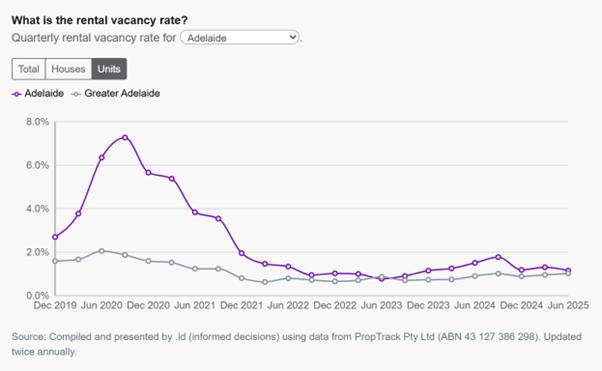
A sharp fall in the vacancy rate for units, from a relatively comfortable 7.27% in June 2020 to just 1.15% in June 2025.
For any household looking for a rental, this represents a much tighter market. For young people on low incomes, it turns a difficult search into an almost impossible one.
The data confirms what frontline workers are reporting: the rental market has not just tightened, it has shifted structurally out of reach for many young renters. That means young people stay longer in crisis beds, fewer new referrals can be accepted and services cannot keep pace with demand.
2. Rents have risen faster than young people’s incomes
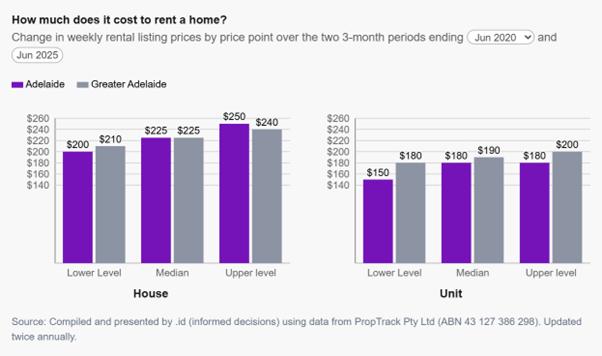
It's not just finding a rental that's hard - then you need to pay for it. Over the same period, median rents in the City of Adelaide have grown well beyond what many young people can afford on Youth Allowance, JobSeeker or casual entry-level wages.
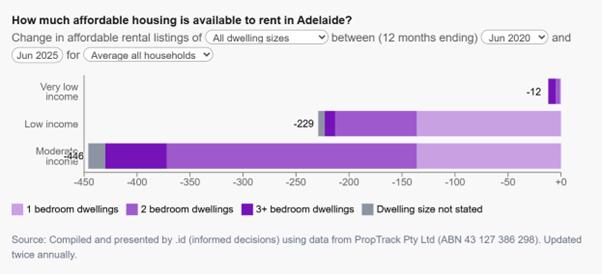
Housing Monitor's affordability view quantifies this shift by pairing local rents with local income bands. In the City of Adelaide between 2020 and 2025, the monitor shows:
-
A net drop of 229 dwellings that were considered affordable for low income households (costing less than 30% of income)
-
A much steeper decline in the one and two bedroom stock that young people rely on when leaving crisis accommodation, and
-
A 75% reduction in affordable two bedroom rentals and a 58% reduction in affordable one bedroom rentals for low income households
In other words, the exact types of homes that support safe exits from crisis accommodation have been disappearing from the affordable stock.
When the market offers fewer affordable one and two bedroom homes at the same time as incomes remain flat, young people are left with no realistic pathway into long-term housing. The result is a system-wide bottleneck: crisis beds are full, but the “next step” housing simply does not exist at a price young people can pay.
3. Neighbourhoods matter: targeting crisis service provision
For councils, it is not enough to know that affordability is worsening. You also need to know where it is worsening fastest so you can target responses.
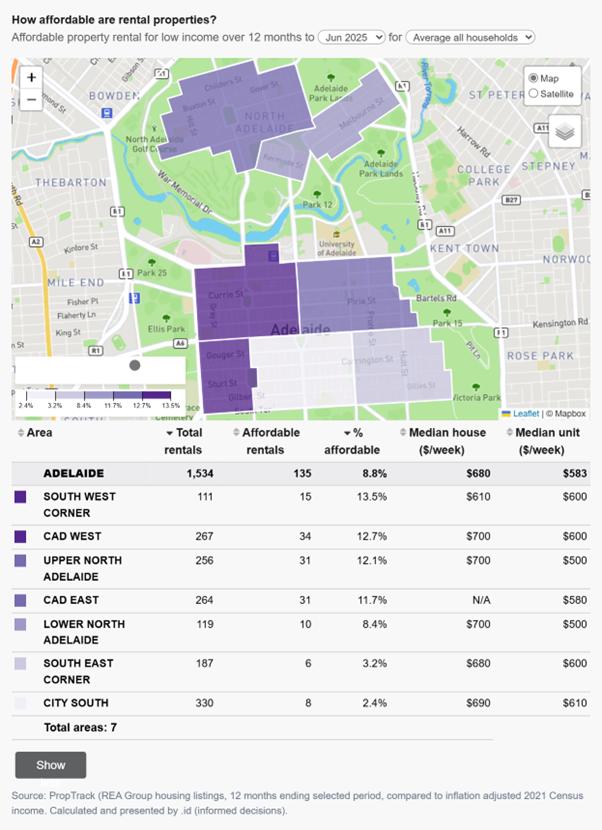
The June 2025 housing affordability view in Housing Monitor highlights clear geographic patterns within the City of Adelaide:
-
Greatest decline in rental listings: City South, where listings fell from 439 in 2020 to 330 in 2025
-
Largest falls in affordability for low income households: Upper North Adelaide and CAD West, with declines of 24% and 16% respectively – even though they still sit among the relatively more affordable locations in 2025
-
Strongest increase in median unit rents: South East and South West, where median unit costs rose by around 50%, or $200 per week.
For services supporting young people, these differences matter. A young person trying to exit crisis accommodation in City South is facing a very different market to someone looking in one of the more affordable pockets of the LGA.
For councils, these insights can inform where to encourage new social and affordable housing, how to work with community housing providers and where to focus planning or advocacy efforts.
Using the evidence for advocacy and action
Youth homelessness services, local governments and community housing providers are all working to prevent young people from cycling through crisis beds. To make the strongest case for resources and reform, they need evidence that is local, current and trusted.
By subscribing to Housing Monitor, councils like the City of Adelaide put a shared evidence base in the hands of local partners, including youth and homelessness services. That shared evidence can provide:
-
A trusted, independent dataset that underpins strategies and funding submissions
-
Visual, easy-to-share charts that show the decline in affordable rentals over time
-
Clear measures of unmet need to support business cases for youth, social and supported housing, and
-
Concrete evidence of rental market failure that young people cannot overcome on their own.
For a Minister or department, “the rental market has dried up for young people” is compelling. “Affordable two bedroom listings declined by 75% while median unit rents rose by $158 per week” is actionable. It creates a clear line between housing market shifts, service pressure and the need for targeted investment.
What this means for your council
If you are working in local government on housing, youth services or community planning, the youth homelessness bottleneck is not just a 'service issue'. It is a housing systems problem that is visible in your local data.
Our housing data can help your council and local partners to:
-
Quantify the scale of youth housing need in your LGA
-
Identify the neighbourhoods where affordable exits from crisis accommodation have disappeared
-
Build robust evidence for social and affordable housing proposals, and
-
Monitor the impact of new supply and policy changes over time.
Ultimately, every extra month a young person spends in crisis accommodation reflects a missing affordable home somewhere in the system. With the right evidence base, councils and their partners are better placed to plan, advocate and invest so that young people can move more quickly into safe, stable housing.
If you’re facing similar pressures in your youth and housing services, let’s look at your local data together. Get in touch to see how Housing Monitor can help your council quantify need, target investment and strengthen your case for more youth and affordable housing.
Image credit: @amazingmikael via canva.com